Personal project
Opportunity Radar
Surfacing company hiring momentum before it's public
Self-directed
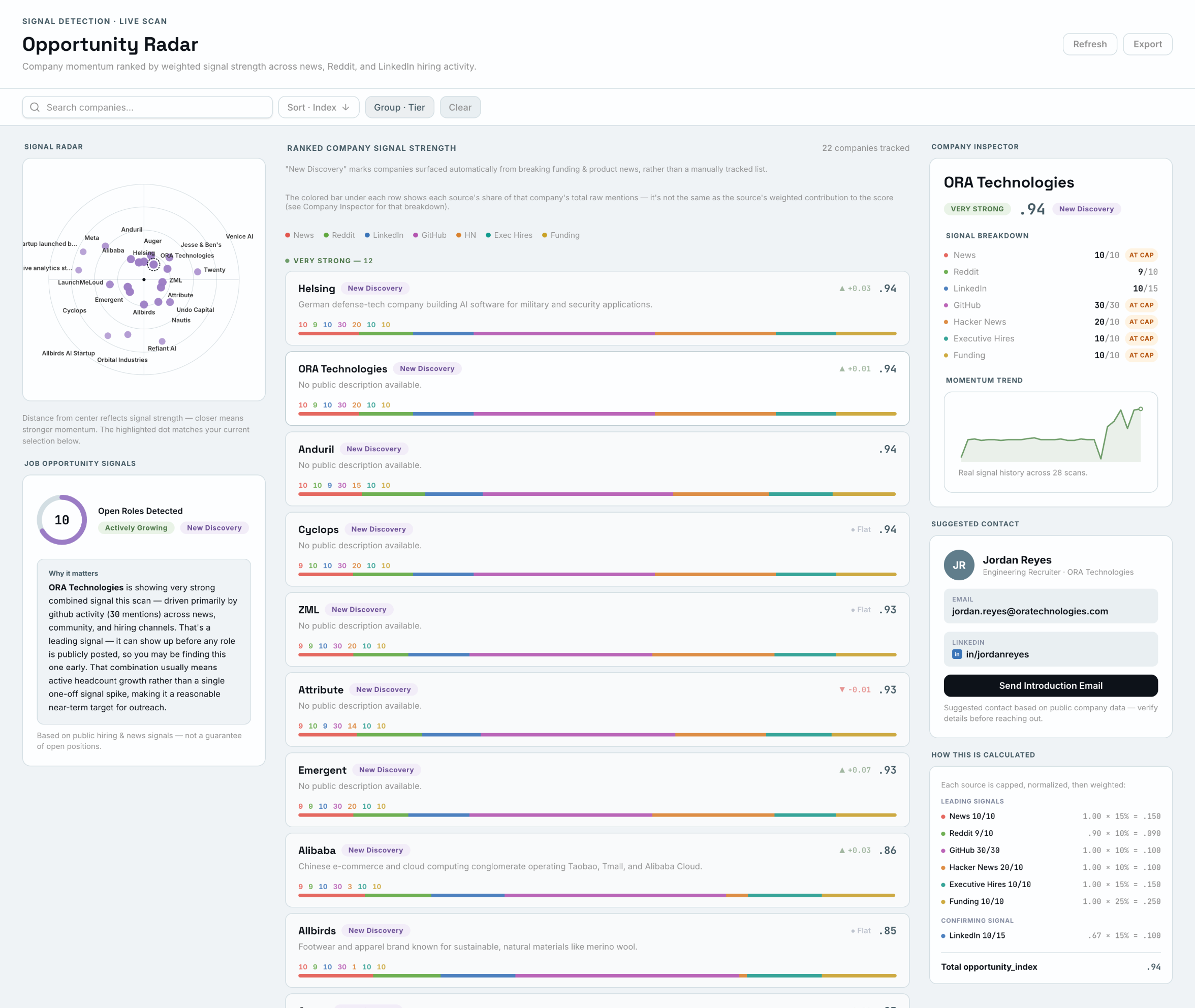
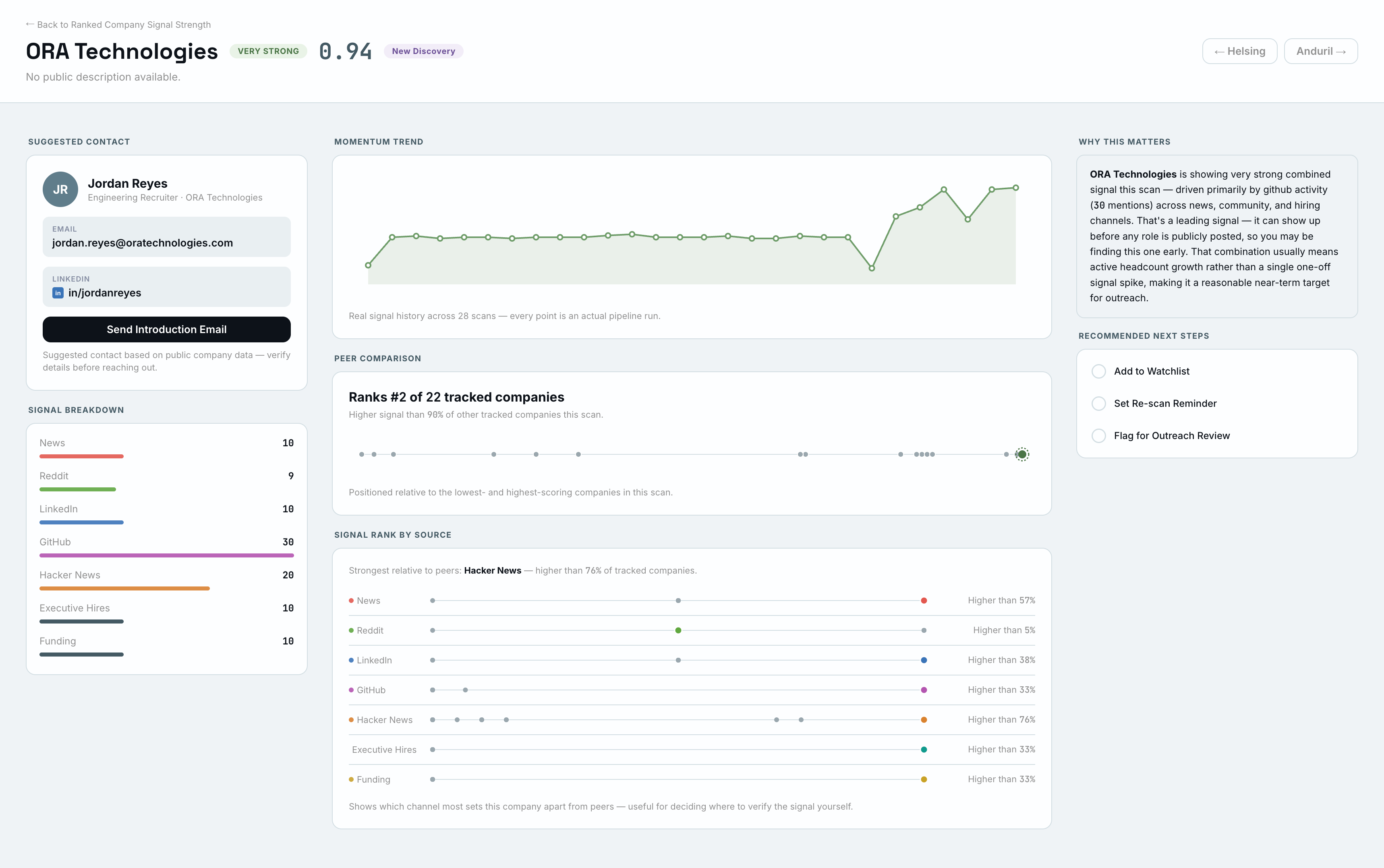
Opportunity Radar is a live dashboard I built to track company hiring momentum in real time. It scans funding announcements, executive hires, news, and community signals across seven independent sources, then scores and ranks companies by how likely they are to be hiring soon — surfacing opportunity before it hits a job board.
n8n
Serper API
Claude
Figma
VS Code
Workflow automation
API integration
Signal scoring
Prompt engineering
UI design
Full-stack build
Kevin
Claude
Job seekers waste hours scrolling job boards, reacting to postings that already have hundreds of applicants by the time they appear.
The real signal — a company about to hire — shows up weeks earlier, scattered across funding news, executive moves, and community chatter.
Challenge: Hiring signals that predict a job opening are scattered across dozens of sources — no single tool aggregates or scores them.
Opportunity: Build an automated pipeline that scans multiple leading indicators — funding, exec hires, hiring activity — and ranks companies by real hiring momentum.
Goal: Ship a working, self-hosted tool that scores companies daily and surfaces the strongest opportunities before they're publicly posted.
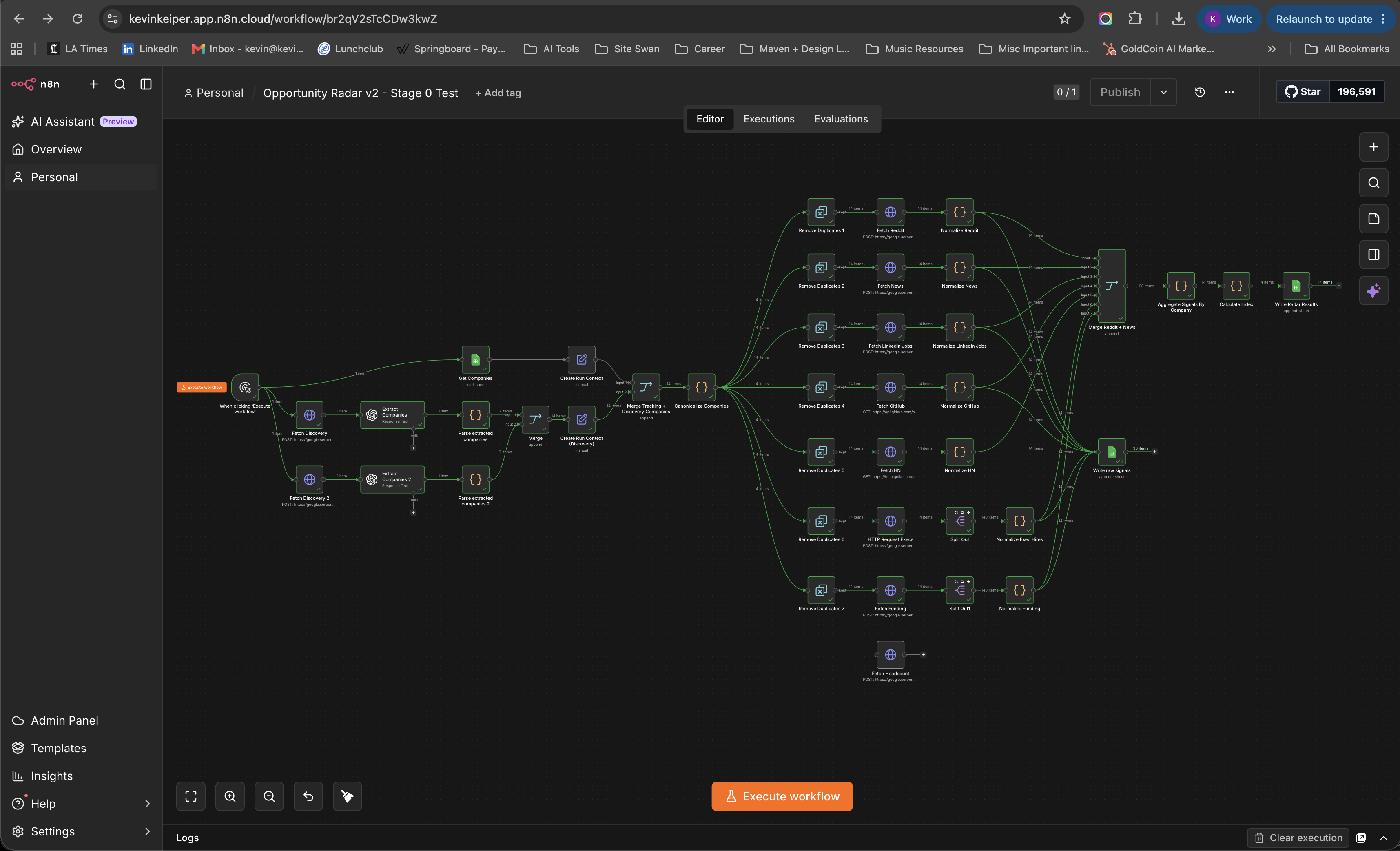
I started in n8n to build the internal mechanism to make it all work...


With the backend scoring pipeline working, I moved into building the interface — pairing a Figma design with Claude-generated front-end code, refined through iteration in VS Code.
.png)

Opportunity Radar went from concept to a live, working tool by pairing automated backend workflows with an AI-assisted front-end build — a full pipeline shipped solo, end to end.
Independent signal sources tracked
Companies scored per run
Person build, powered by Claude
Shipped a fully working dashboard, live and publicly accessible.
Proved a weighted, multi-source scoring model can meaningfully differentiate companies.
Built the entire pipeline — backend, scoring, and UI — using Claude as an AI pair-programmer throughout.
Building a real signal pipeline meant debugging data end-to-end — from a single wrong field name silently breaking a formula, to signals that looked strong but weren't actually differentiating anything.
A single mismatched field name can silently break an entire scoring formula — always verify output, not just that a node ran.
A signal that's maxed out for every company isn't actually a signal — it needs a tighter query, not just a slot in the formula.
Pairing with Claude across n8n, Figma, and VS Code made it possible to move from idea to shipped tool in one continuous build session.
A look at the live tool and the workflow behind it.